
What are you really looking for when you book a table at a Michelin-starred restaurant in the Langhe? Maybe the thrill of a dish you won’t forget, the scent of Alba white truffle filling the room, or simply the desire to sit down somewhere that someone has thought long and hard about, for weeks, sometimes late at night, deciding what to put on your plate.
At Locanda del Pilone, a Michelin-starred restaurant, the menus come out of stories, out of suppliers you pick up the phone to call, out of journeys that unfolded over time, out of a kitchen team that argues and experiments.
This article takes you inside how that kitchen works and why the Piemonte menu, in particular, is far more than a list of dishes.
Discover the menus and book your table →
The Piemonte Menu: When Tradition Becomes Storytelling
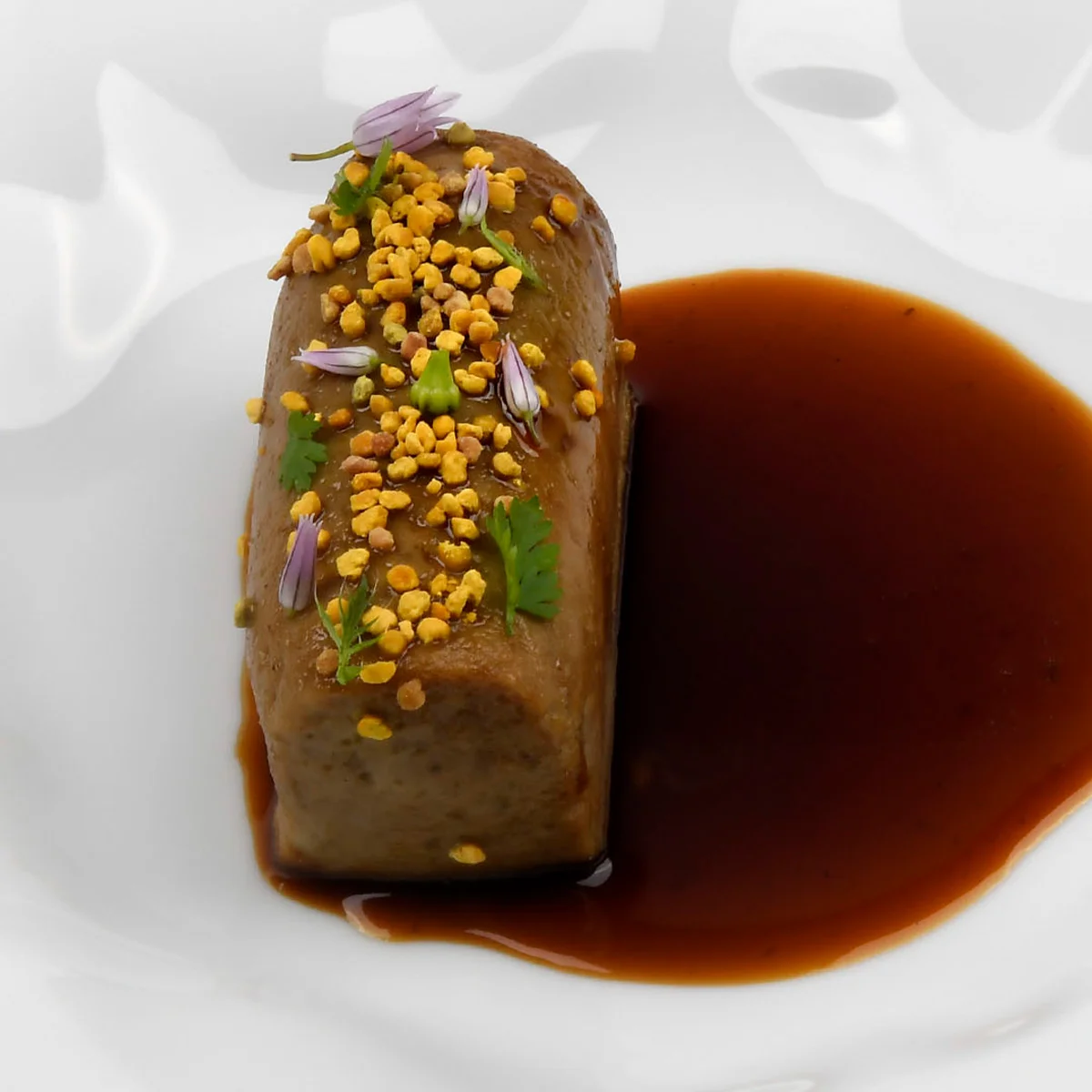
The Piemonte menu is the heart of what the restaurant at Locanda del Pilone offers. Five courses that always start from a base recipe, the local one, the classic one, and read it again through contemporary eyes, without ever betraying it.
The progression opens with “Sloweat” grilled snails with Pilpil sauce, a starter that immediately captures the philosophy of the house: giving dignity to less conventional ingredients by working them with technique and respect. Pilpil sauce is a Basque preparation based on the natural gelatin released by fish during cooking, a choice that makes clear from the outset how far Federico Gallo’s influences reach beyond the borders of Piedmont.
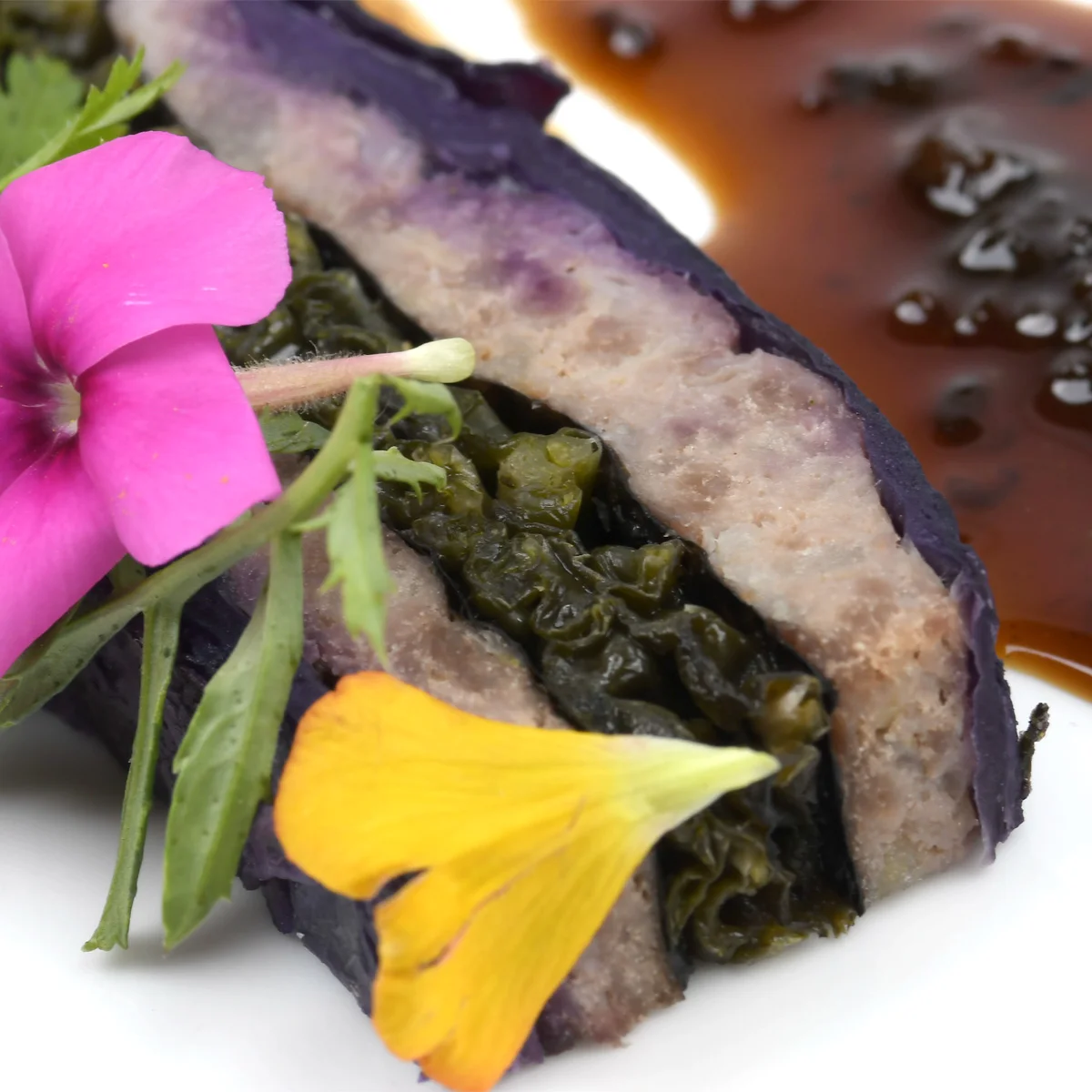
Next comes Capunet, veal, savoy cabbage, foie gras, and hooked black truffle. Capunet is a stuffed savoy cabbage roll typical of Piedmont’s farmhouse tradition. Here it’s reinterpreted with strikingly elegant ingredients, while the structure of the original dish stays intact.
The third course may be the one most loaded with personal affection: Nonna Lina, green ravioli with wild garlic and colatura di alici (a liquid sauce obtained from anchovies cured under salt, similar to Roman garum). A name that’s already a story. “I could name it after Nonna Lina because it comes from a childhood memory,” says Federico Gallo. It’s one of those dishes where the chef’s memory merges with the ingredients, and the result has a precision you can’t explain, only feel.
Then come the Frogs, parsley and garlic risotto with fried frog legs, and Sambuco; a main course of Sambucana sheep (a sheep breed native to Piedmont’s Alpine valleys): lamb or mature sheep, depending on the day’s interpretation. This last dish deserves a moment’s thought. Gallo deliberately chose not to work with Piedmontese Fassona beef, ever-present on Langhe tables, preferring to make room for animals typical of the area but less commonly used, bought whole and worked cut by cut: “I’ve always liked the idea of not wasting anything.”
The full menu, including a dessert of your choice, is offered at €150 per person. For anyone who prefers to build their own dinner, there’s also the “À la Carte” option. Two courses chosen from across the different menus plus dessert at €110, or three courses plus dessert at €140. The menus are designed for the whole table, and the same pricing structure applies to Acqua Dolce and Orto as well.
How the Dishes Come to Life: Seasonality, the Kitchen Team, and the Land
The process is fluid, human, unpredictable.
Sometimes the idea arrives at night, in the car on the way home. Other times it comes out of a conversation with the team, a group that’s worked together closely for years, each person with a different set of experiences, bringing an unexpected point of view. “The great thing is that the other guys come from different professional backgrounds. What doesn’t work in my head is perfect in someone else’s, and a good dish comes out of it.”
Seasonality is the thread that holds everything together. The menus at Locanda del Pilone follow nature’s calendar with almost absolute faithfulness. When an ingredient runs out, it comes off the menu. The kitchen works with two vegetable gardens, and how fast availability changes determines how fast the dishes change: “when he tells me ‘I’m out of green beans,’ the green beans are done. Going to look for them somewhere else isn’t how we work.”
The seasonal structure is clear. From spring through the end of September, the three main menus are on offer. In October, Alba white truffle arrives, with a dedicated menu, simpler and more traditional. “Over time I’ve realized there’s no point making complicated dishes with white truffle. People want those three or four things, and we give them those three or four things.”
The choice of suppliers, too, follows a logic that’s personal before it’s professional. Gallo has built a network of more than twenty local producers, selected almost always for character before catalog: “the qualities, 99% of the time, are human ones. I have to like the person.” It’s an approach that makes conversations like this one with his trusted fishmonger possible: “I’d like to try hot-smoked tench.” “Look, I think cold works better, but I’ll send it to you both ways, then you choose.” He was right.
Discover the full restaurant experience →
The Other Menus: Acqua Dolce and Orto
The Acqua Dolce menu is perhaps the most personal expression of Gallo’s cooking. “The first restaurant I worked in was a lake fish restaurant,” and from there comes a passion for freshwater fish that today sets Locanda apart on the Langhe dining scene, where saltwater fish is almost the norm. The menu features salmon trout aged in rice with XO sauce, steamed eel with carpione vinegar sauce (a vinegar-based marinating technique typical of Piedmont and northern Italy), Pastificio Bossolasco spaghetto with smoked tench and Calvivus caviar, mushroom and crayfish ravioli, and grilled sturgeon with porchetta. That last pairing brings together two distant regional traditions with a surprising result.
The Orto menu is vegetarian, though Gallo doesn’t love the label, which risks making it sound like something marginal. In reality it’s a progression that treats every vegetable like any other raw ingredient. With the same attention, the same technique, the same curiosity.
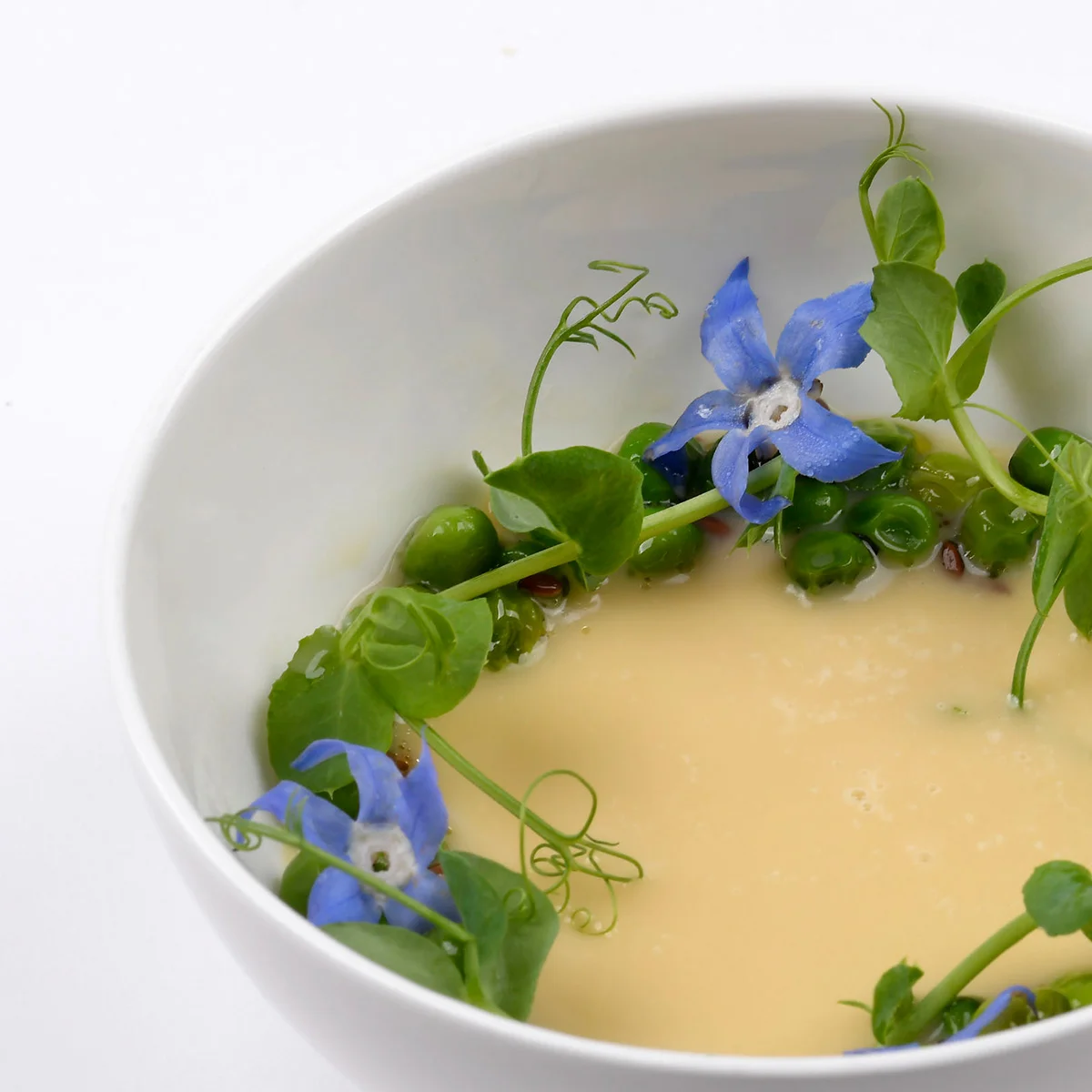
It starts with pea chawanmushi (a steamed custard of Japanese origin, reworked here with Parmigiano water and cardamom), moves through trombetta zucchini with mint and licorice, agnolotti del plin with Cremus di Lo Puy (a creamy cheese made in Piedmont) and wild herbs, asparagus and fava bean ravioli, all the way to grilled lettuce heart with Chartreuse and hazelnuts. “We have a lot of fun with vegetables. We treat them exactly the way we’d treat any other main ingredient.”
Federico Gallo’s Story: From Cruise Ships to Michelin Stars
Federico Gallo was born in Turin. Cooking didn’t come as a calling, and he tells it himself with disarming honesty. At the end of middle school, knowing he’d have to move to Tuscany, he looked for a school close to home. There was the culinary institute, and then there was an article in a newspaper, this is 2000-2001, about chefs on cruise ships, travel around the world, and serious paychecks. “I said: I’ll travel the world and make a ton of money. So that’s how it all started.”
And he did travel the world. Los Angeles, Mexico, northern Europe. But it was Mexico in particular that left the deepest mark, not right away, but over time. That cuisine, seemingly so far from ours, shared something essential with the Italian tradition: the biodiversity of the ingredients, the recipe that changes from region to region and from family to family, the respect for the raw ingredient. Those are values you find today in the Piemonte menu, in the dishes of the Orto menu, in the philosophy behind the local suppliers. Different cultures meeting without overlapping, each one still recognizable.
The turn toward fine dining came out of necessity: “I realized it couldn’t all be that, there had to be something more.” From there, the right path “where there’s more attention to everything: to the guest, to the ingredient.”
Arriving at Locanda del Pilone in 2015, Gallo found a place with a history and a style already formed. It took him time to get to doing things the way he’d imagined them. Today, ten years in, that kitchen is unmistakable. Piedmontese tradition as the starting point, international experience as the language, apparent simplicity as the goal. “The dish has to reach you immediately, simply, emotionally. That you spent three days making it, people don’t need to know. It speaks for itself.”
Choosing What to Eat
Sitting down at the restaurant at Locanda del Pilone means choosing a story, and each menu offers a different one. Piemonte for those who want to taste the territory in every bite. Acqua Dolce for those who love discovering unusual ingredients handled with the same care as the great classics. Orto for those who want to be surprised by the depth of the vegetable.
Rounding out every dinner, three desserts with identities of their own:
- Alba 2.0 (porcini mushroom cream, fior di latte gelato, and wild berry preserve)
- Duchessa (hazelnut and zabaione cream with candied sour cherries)
- Cassis (yogurt mousse, blackcurrant semifreddo, blackberry and yuzu sorbet)
All of this takes place in a resort with panoramic views over the vineyards of the Langhe, a UNESCO World Heritage Site since 2014, backed by a cellar of more than 1,400 labels, a dedicated sommelier, and the option to name the wine you’d like when you book, along with a full calendar of activities in the Langhe, from truffle hunting to hot-air ballooning. Locanda is also a Krug Ambassade, a recognition given by Maison Krug to restaurants around the world that embody its philosophy of excellence: a title that in the Langhe belongs to this property alone.
Whichever menu you choose, know that the dishes on your plate have a story behind them, of travels, of people, of nights when someone thought it over until the right idea came. And here in the Langhe, you can taste it.
FAQ Section
How many tasting menus does Locanda del Pilone offer?
Locanda del Pilone offers three main tasting menus: Piemonte, Acqua Dolce, and Orto. Starting in the fall season, a menu dedicated to Alba white truffle is added, plus a special themed menu that changes every year. There’s also an “À la Carte” option with two or three courses chosen from across the different menus.
What’s included in the Piemonte menu?
The Piemonte menu includes five courses inspired by Piedmont’s culinary tradition: “Sloweat” grilled snails with Pilpil sauce; Capunet with veal, savoy cabbage, foie gras, and hooked black truffle; Nonna Lina with green ravioli, wild garlic, and colatura di alici; Frogs with parsley risotto and fried frog legs; Sambuco with Sambucana sheep. The full menu with dessert is €150 per person.
Is the Orto menu suitable for vegetarians?
Yes, the Orto menu contains no meat or fish. It does use dairy and eggs, so it isn’t vegan. It’s a vegetarian progression that treats garden ingredients as the absolute stars of every course.
How often do the dishes at Locanda del Pilone change?
The dishes change with the seasonality of the ingredients, and the changes can be very frequent, especially on the Orto menu, where the availability from the gardens the kitchen works with directly determines the day’s courses. The main menus change with the seasons; in October, Alba white truffle arrives with a dedicated menu.
How do you book a table at Locanda del Pilone?
You can book online, or contact the property directly at +39 0173 366616 or by email at info@locandadelpilone.com. When booking, you can indicate any wine preferences.